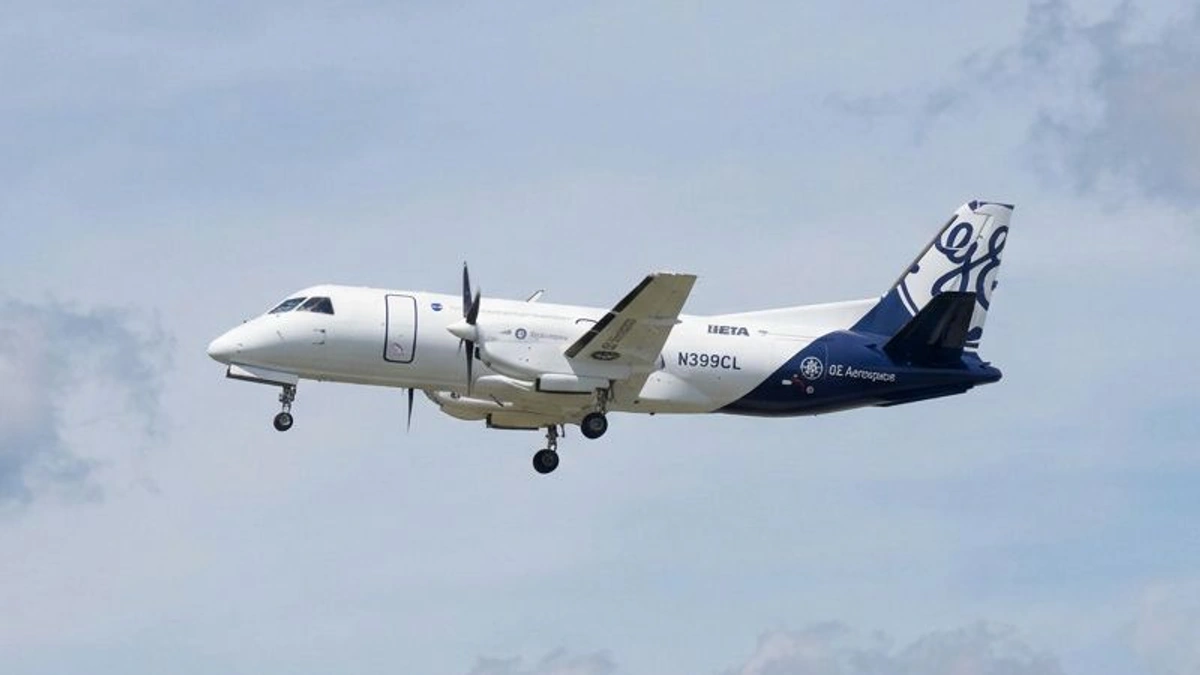
In the United States, GE Aerospace and its partners have taken a hybrid-electric aircraft powertrain beyond ground testing and into high-altitude flight. The programme, presented publicly at Farnborough in the United Kingdom in July, offers a concrete way to understand a technology often described only in terms of future aircraft.
GE's recent discussion of the technology is a useful reason to revisit the work, but the flight milestone is not a new event on 12 October. The company announced it on 20 July.
What actually flew?
The test aircraft is a modified Saab 340B, with a system combining a gas turbine, electrical machinery and energy storage. GE reports flights above 30,000 feet and a hybrid-powered flight lasting more than two hours. NASA, BETA Technologies and Boeing are partners in the programme.
GE describes a CT7-based installation and a megawatt-class electrical system. The unusual installation on the aircraft's right side supports the test configuration; it should not be mistaken for the appearance of a standard airline Saab 340.
Two sources of power, one propulsion task
In a parallel hybrid arrangement, a turbine and an electric motor can contribute mechanical power to propulsion. A battery supplies electrical energy, while a motor-generator can also participate in charging when operated as a generator. The useful distinction is between electricity supplied to a motor and the mechanical output that ultimately turns a propeller.
That makes hybrid-electric different from an aircraft relying entirely on batteries. Keeping a fuel-burning engine in the system changes both the opportunities and the compromises. A demonstration of the combination does not mean an aircraft has become emissions-free.
The integration is the engineering story
NASA's account traces the work back over more than fifteen years of research. It identifies power handling, heat, batteries and the integration of the engine with the aircraft as important challenges. Lighter components and smaller electrical equipment were part of making a practical installation possible.
At NASA's Electric Aircraft Testbed in Sandusky, Ohio, an integrated propulsion system underwent testing in 2022 under conditions simulating 45,000 feet. Simulated altitude testing and subsequent aircraft flights provide different kinds of information: one lets engineers examine equipment under controlled conditions, while the other places it in an operating airframe.
NASA says the technology is intended to inform power systems for aircraft around the size of a regional jet. That describes the research ambition, not a certified passenger aircraft available for airlines to order.
What would make it commercially useful?
For an airline, the question extends beyond whether the motor works. A new propulsion system must fit into an aircraft's weight, maintenance and operating requirements. Any savings have to be assessed at that complete-aircraft level, rather than inferred solely from the presence of an electric component.
The published demonstration does not establish a fleet-wide fuel-saving percentage, a ticket-price reduction or a date when passengers will fly commercially on this system. Its significance is more specific: equipment developed through years of laboratory and ground work has operated in flight.
The next useful evidence will show how that experience feeds into later designs and the requirements for a commercial application. For now, the Saab testbed provides a visible bridge between a promising electrical architecture and the much larger task of integrating it into everyday aviation.